
About City Palace
The magnificent City Palace of Jaipur stands as a sprawling high-walled complex right in the heart of the “Pink City,” serving historically as the ceremonial and administrative seat of the Maharajas of Jaipur and now as a significant cultural landmark with a part of the complex still functioning as the private residence of the current royal family thereby preserving a tangible continuity of a living royal presence. Construction of the palace began soon after Maharaja Sawai Jai Singh II, the founder of Jaipur moved his capital from Amber in 1727 due to population increase and water shortage with the complex built on the site of his former hunting lodge covering many acres and adhering meticulously to the principles of Vastushastra under the architectural guidance of Vidyadar Bhattacharya. The palace is a unique and special complex completed around 1732 that beautifully showcases a striking blend of Rajput, Mughal and even some European architectural styles constructed predominantly from red sandstone, pink sandstone and white marble which contributes to the city’s famed “Pink City” moniker—a stucco colour scheme introduced by Maharaja Ram Singh in honour of the Prince of Wales’s visit in 1876.
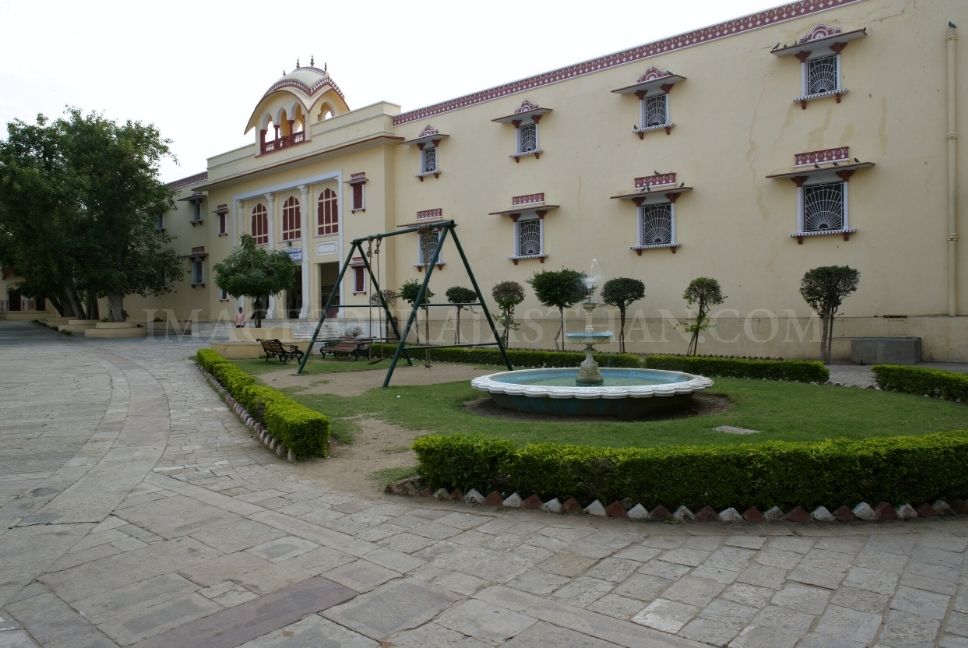
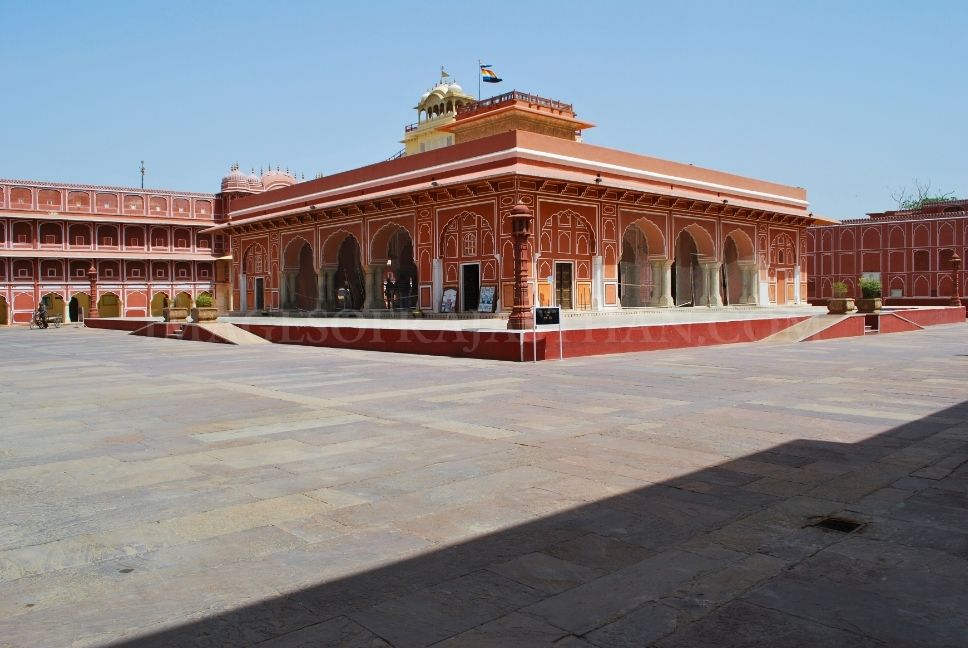
Visitors typically enter the complex through the Udai Pol gate on the northwest side (as the grand Tripolia Gate is reserved for the royal family), which leads ultimately to the palace’s numerous courtyards and significant buildings, including the small Diwan-i-Am courtyard followed by the main courtyard centered on the raised Diwan-i-Khas (Hall of Private Audience). This open-sided hall with its roof raised on marble pillars was the critical place where all important decisions of state were historically taken and it famously houses two immense silver urns or gangajalis, each more than 1.5 meters high with a capacity of 4000 liters (818 gallons) which are listed in the Guinness Book of Records as the largest crafted sterling silver objects in the world commissioned by Maharaja Sawai Madho Singh II to carry sacred Ganges water on his journey to London for King Edward VII’s coronation in 1902. Adjacent to this lies the exquisite Pritam Niwas Chowk, famously known as the “Peacock Courtyard,” which is adorned with four small richly decorated gates (Ridhi Sidhi Pol), each representing one of the four seasons and dedicated to a specific Hindu deity such as the Northeast Peacock Gate for autumn (dedicated to Lord Vishnu) and the Northwest Green Gate for spring (dedicated to Lord Ganesha) making it a favorite for photographers.
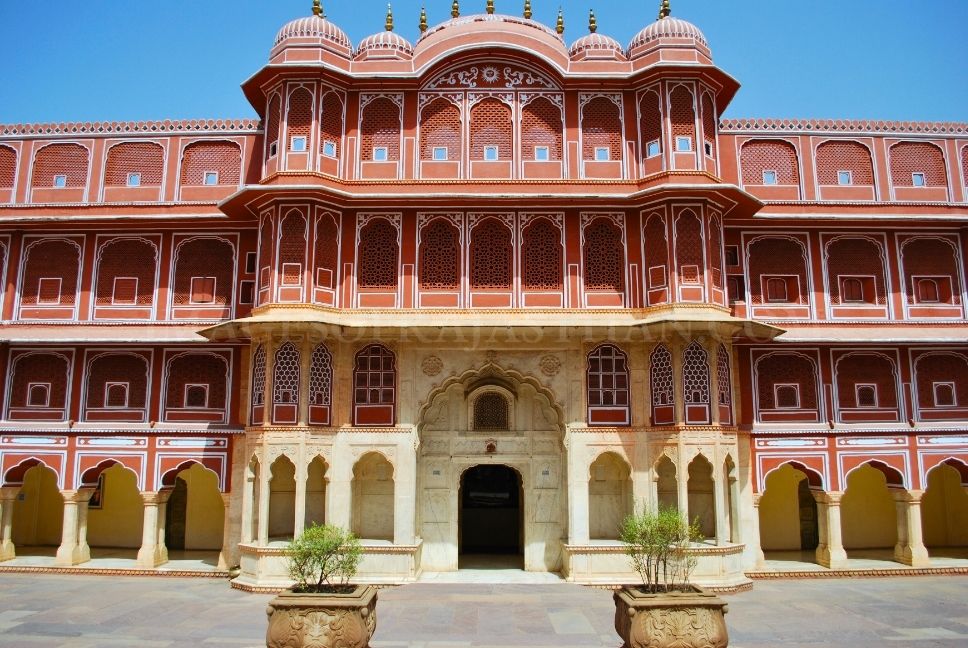
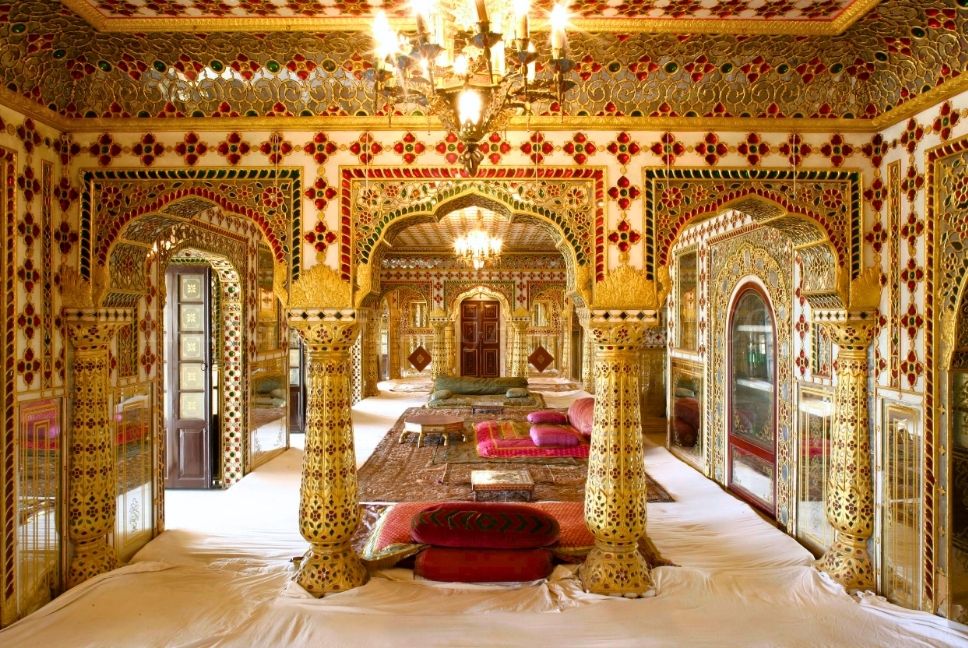
The Pritam Niwas Chowk offers the best view of the soaring, seven-storey Chandra Mahal the private residence of the royal family (closed to the public) whose slope-shouldered summit flies the Maharaja’s flag and its miniature companion, a tradition linked to the title ‘Sawai‘ meaning “one and a quarter,” conferred upon Jai Singh by Emperor Aurangzeb. On the eastern side of the Diwan-i-Khas courtyard is the elaborate Mubarak Mahal (Welcome Palace), built in 1899 as a reception hall with finely carved stone arches and identical facades on all four sides, which now houses the museum’s Textile Gallery showcasing elaborate royal wardrobes including quilted atam sukhs and the fine “billiard dress” of Ram Singh II. Furthermore, the complex includes the Diwan-i-Am (Hall of Public Audience) also known as the Sabha Niwas, featuring marble columns and beautiful painted ceilings which now displays a collection of ornate palanquins ancient manuscripts and miniature paintings from the Mughal and Jaipur schools. The Sileh khana (Armoury), located in a further series of rooms, showcases the arms used by the Kachhwaha Rajputs including swords with chiselled animals and a beautifully painted shield featuring the clan goddess Shila Mata. Finally the City Palace complex is a “living heritage,” with the Sarvato Bhadra (Diwan-e-Khas area) continuing to be used for significant rituals like the coronation of Maharajas and royal festivals like Dusshera adding depth to the visitor experience which as the Sawai Man Singh Museum now preserves and exhibits this magnificent legacy for the public.
Quick Overview
The City Palace, built by Maharaja Sawai Jai Singh II, is an architectural marvel at the heart of Jaipur. This vast complex seamlessly blends Rajput and Mughal styles, featuring ornate gates and magnificent courtyards. Highlights include the Diwan-i-Khas, which houses the world's largest silver vessels, and the beautiful Pritam Niwas Chowk with its four seasonal gates. Still partially a royal residence, the palace operates as the Sawai Man Singh Museum, offering visitors a glimpse into the opulent history, textiles, and weaponry of Jaipur's royalty.